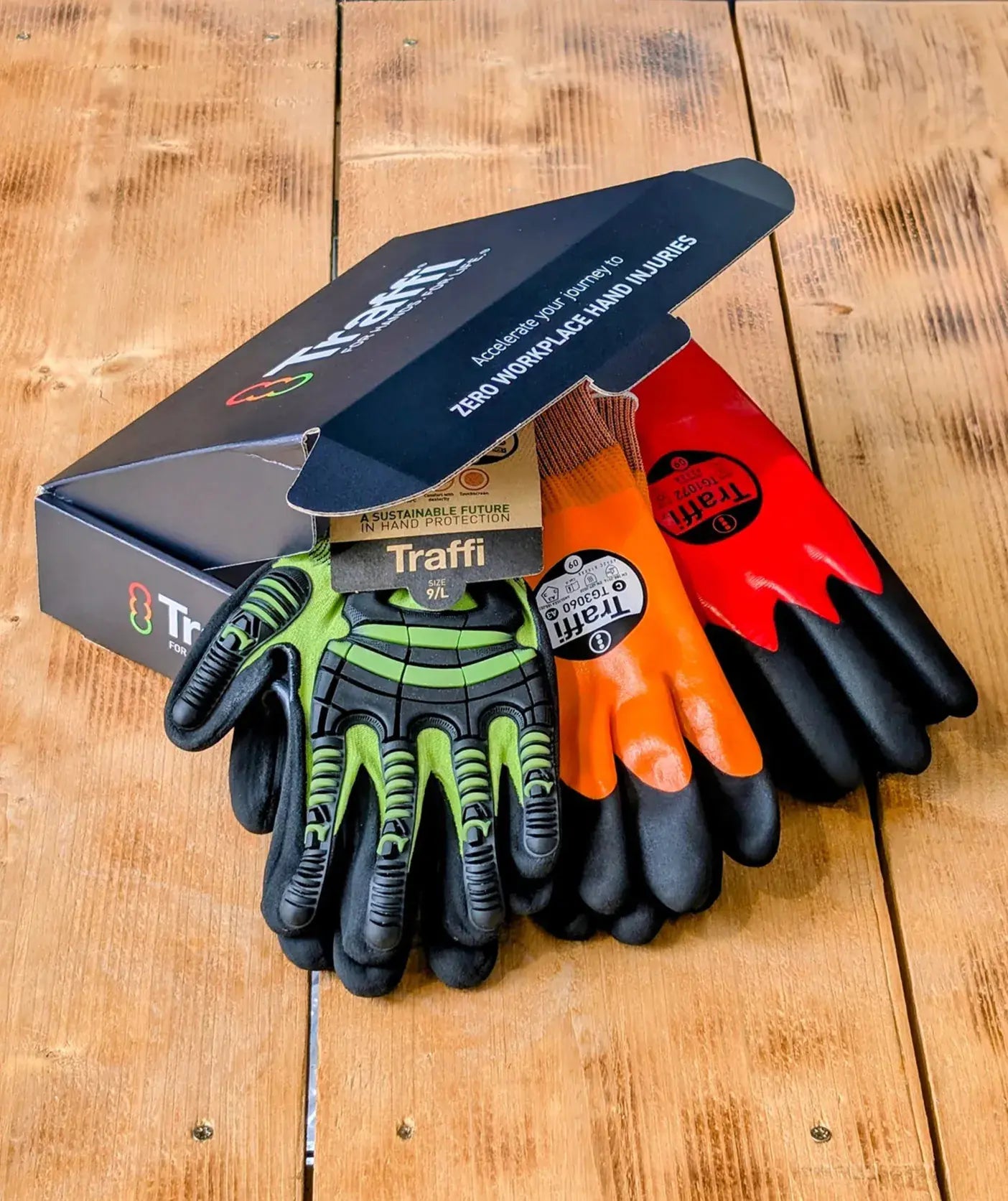
Our hands are amazingly versatile, allowing us to carry out everyday tasks and precision movements with minimal effort, which also means they are exposed to a multitude of hazards in the workplace.
Cuts and lacerations are the most common type of hand injury, and wearing the correct safety glove for the task at hand is crucial. Understanding EN388:2016 is an important factor when choosing the right gloves for your day-to-day tasks.

EN 388:2016 + A1:2018 (EN 388) is the European safety standard that certifies and rates protective work gloves against mechanical risks. Gloves bearing this rating are tested across five specific categories, with higher numbers (and letters) indicating better protection.
| TEST | PERFORMANCE LEVEL |
|---|---|
| Abrasion Resistance | Level 1 to 4 |
| Coupe Blade Cut Test | Level 1 to 5 |
| Tear Resistance | Level 1 to 4 |
| Puncture Resistance | Level 1 to 4 |
| Cut Resistance (EN ISO 13997) | Level A to F |
| Impact (Optional) | Marked with a "P" |
High performance fibres and materials, such as fibreglass or steel, are used to achieve greater levels of cut protection in safety gloves. Because of this, testing procedures and classifications are regularly improved and adapted to ensure the degree of cut protection is truly representative.
ABRASION RESISTANCE

Test samples from the palm are rubbed against 180-grit abrasive paper under constant load using an abrasion tester. The protection level is determined by the number of cycles required to wear through the material, with a higher cycle count indicating greater abrasion resistance.
Four samples are tested in this way, with the overall performance level determined by the lowest result.
CUT RESISTANCE - COUPE TEST

Until 2016, the Coupe Blade Cut Test was the standard method for measuring cut protection.
A rotating circular blade cuts a sample taken from the palm at a constant speed and load. Results are determined by the number of cycles needed to cut through the sample and by calculating the degree of wear on the blade. This is expressed as an index (Levels 1 to 5), with higher levels indicating greater resistance to cut by a moving blade.
TEAR RESISTANCE

In the tear resistance test, four samples from the glove's palm are pulled apart using a tensile testing machine. The machine's jaws move apart at a speed of 100 mm per minute, and the force required to propagate the tear determines the performance level (Levels 1 to 4), with Level 4 indicating the strongest material.
For single materials, the performance level is based on the lowest result of the four tests. For multiple, unbonded layers, each layer must be tested individually, and the performance level is determined by the lowest individual result of the most tear-resistant material.
PUNCTURE RESISTANCE

Puncture resistance is measured by driving a stylus, approximately the size of a standard roofing nail, through a palm sample using a controlled force.
The lowest result from four tests determines the performance level (Levels 1 to 4), with Level 4 representing the highest level of puncture resistance.
CUT RESISTANCE - EN ISO 13997 (TDM BLADE TEST)

For safety gloves manufactured using materials designed to have a blunting effect on blades, additional cut protection testing must be carried out.
Any sample fabric tested using the Coupe Blade Cut Test that causes significant blade blunting will be marked with an X for the Coupe test result and instead tested using the EN ISO 13997 method. This ensures the level of protection provided by the glove is measured as accurately as possible.
A straight blade cuts the sample at a constant speed while the force is gradually increased until breakthrough occurs at a 20 mm cut length. The force required, measured in Newtons, determines the protection rating from A to F, with F denoting the highest level of cut resistance.
IMPACT RESISTANCE