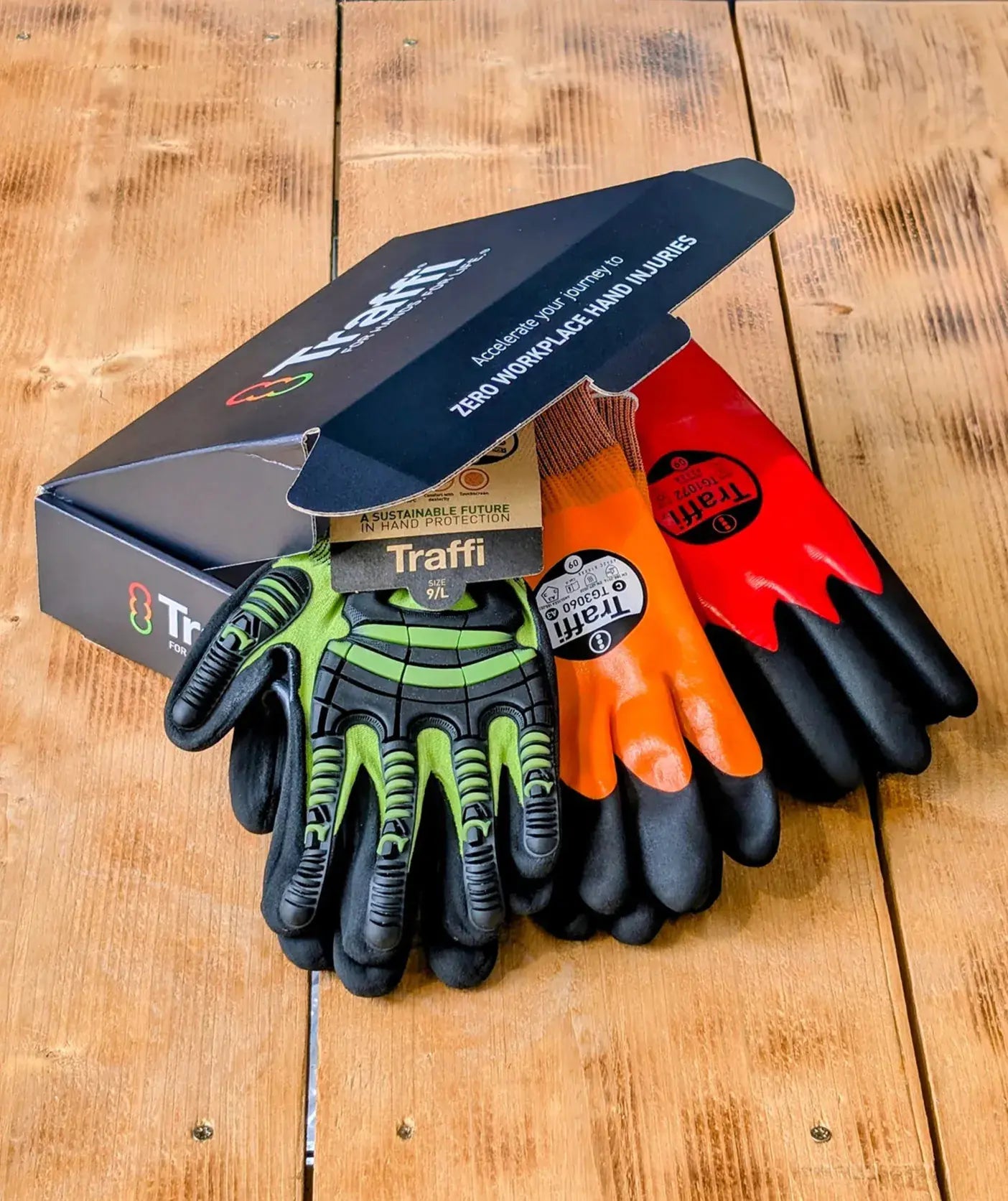
The markings on safety gloves refer to the recognised safety standards that the glove has met. They are designed to help users understand the level of protection a glove offers, making it easier to select the right solution based on the specific hazards present in their working environment.
Below is an overview of the key standards and what each one indicates.
EN 388:2016+A1:2018 - MECHANICAL RISKS

EN 388:2016 + A1:2018 (EN 388) is the European safety standard that certifies and rates protective work gloves against mechanical risks. Gloves bearing this rating are tested across five specific categories, with higher numbers (and letters) indicating better protection.
| TEST | PERFORMANCE LEVEL |
|---|---|
| Abrasion Resistance | Level 1 to 4 |
| Coupe Blade Cut Test | Level 1 to 5 |
| Tear Resistance | Level 1 to 4 |
| Puncture Resistance | Level 1 to 4 |
| Cut Resistance (EN ISO 13997) | Level A to F |
| Impact (Optional) | Marked with a "P" |
Want to dive deeper into the EN 388:2016 standard?
Read our in-depth blog here
ANSI/ISEA 105:2024 - MECHANICAL HAZARDS

ANSI/ISEA stands for the American National Standards Institute/International Safety Equipment Association. This is a voluntary US industry consensus standard.
Like EN 388, ANSI/ISEA 105:2024 classifies glove performance for:
- Mechanical hazards (cut, abrasion and puncture)
- Hypodermic needle puncture
- Chemical performance (where applicable)
- Impact protection
The 2024 update standardises labelling through a pentagram pictogram, displaying abrasion, cut and puncture ratings in a single badge.
PERFORMANCE LEVELS
| TEST | PERFORMANCE LEVEL |
|---|---|
| ANSI Cut | Level A1 to A9 |
| ANSI Abrasion | Level 0 to 6 |
| ANSI Puncture | Level 0 to 5 |
NOT SHOWN ON THE PICTOGRAM
| TEST | PERFORMANCE LEVEL |
|---|---|
| ANSI Hypodermic Needle Puncture | Level 0 to 5 |
| ANSI Impact Protection | Level 1 to 3 |
CE MARK - CONFORMITY

The CE Mark is a mandatory conformity mark indicating that a product complies with EU health, safety and environmental protection legislation.
EN ISO 21420:2020

EN ISO 21420:2020 specifies the general requirements and relevant test procedures for glove design and construction, innocuousness, comfort and efficiency.
The information pictogram indicates the availability of user information, including:
- Manufacturer's name, trademark or other identification
- Glove designation
- Glove size
- Applicable glove standards and ratings
- Warnings, allergies, care instructions, shelf life and storage conditions (User Instructions)
EN 511:2006 - COLD PROTECTION

EN 511:2006 specifies the performance requirements and test methods for protection against cold risks.
To claim EN 511:2006 certification, gloves must also achieve at least Level 1 for both abrasion and tear resistance under EN 388:2016.
Gloves are tested across three categories, with higher numbers indicating better protection.
| TEST | PERFORMANCE LEVEL |
|---|---|
| Convective Cold | Level 0 to 4 |
| Contact Cold | Level 0 to 4 |
| Water Penetration | 0 (Fail) or 1 (Pass) |
EN 407:2004 - THERMAL RISKS


The EN 407:2004 standard measures a glove's thermal resistance across six different tests.
| TEST | PERFORMANCE LEVEL |
|---|---|
| Limited Flame Spread | Level 1 to 4 |
| Contact Heat | Level 1 to 4 |
| Convective Heat | Level 1 to 4 |
| Radiant Heat | Level 1 to 4 |
| Small Splashes of Molten Metal | Level 1 to 4 |
| Large Quantities of Molten Metal | Level 1 to 4 |
Products claiming flame resistance are marked with the flame icon within the shield pictogram.
Products providing heat protection without flame resistance are marked with the three-line heat icon within the shield pictogram.
LEARN MORE ABOUT SAFETY GLOVES
If you want to go beyond glove markings and build a more complete understanding of glove selection, coatings and glove care, explore our Ultimate Guide to Safety Gloves.
It's a practical resource designed to help you make safer, more informed decisions when selecting hand protection.